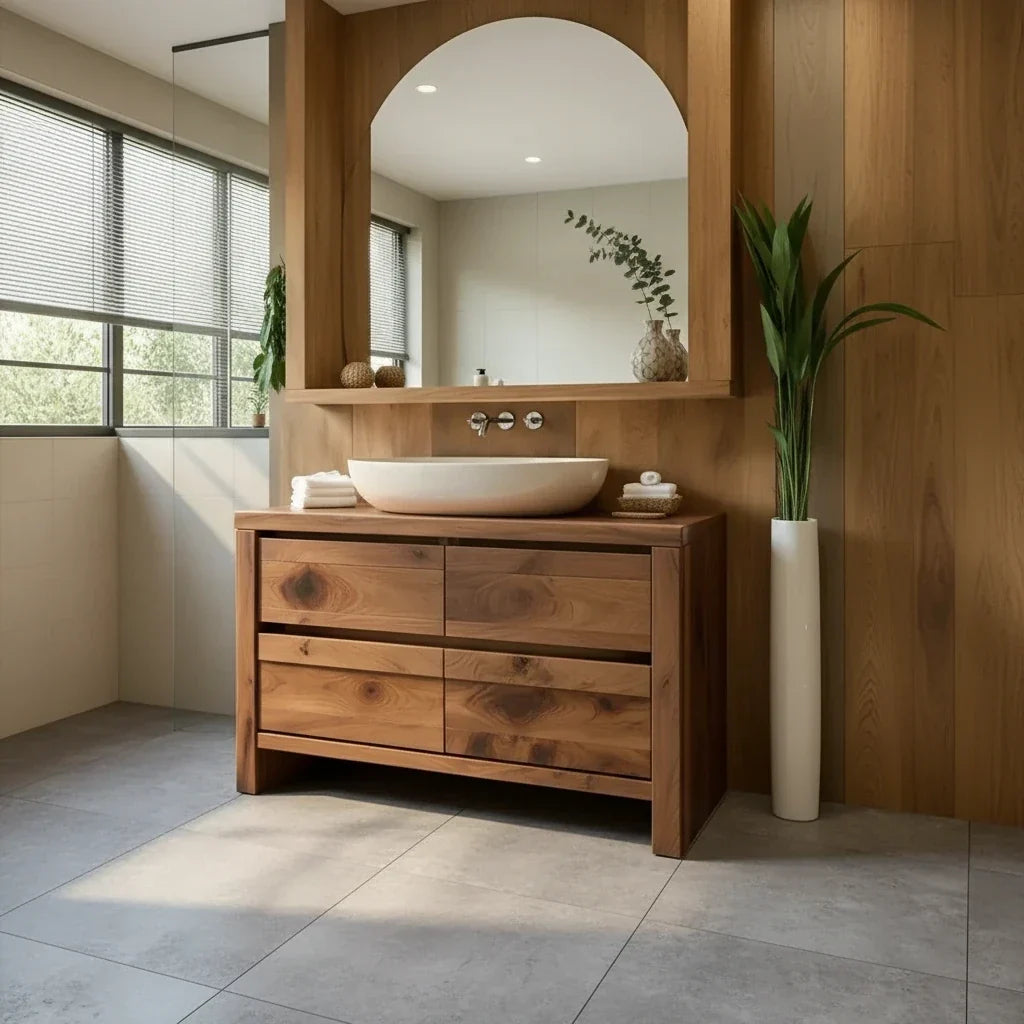
Statement Bathroom Vanities: A Shaped Body or a Decorated Box
What Makes a Bathroom Vanity Look One-Off?
Where the shape is. Almost everything sold as a statement vanity is a rectangular box with something done to the front - carved doors, fluting, a bold grain - and that can be very good indeed, but it is decoration applied to a standard carcass. The other kind is rarer: the body itself is not a rectangle. The sides roll over and run to the floor as one curve, or the case pulls in at the waist and flares again at the ends, or the whole frame turns at every corner so there is no square edge on the piece anywhere. That difference decides where the vanity reads from.
A carved front works close up and in raking light - the hollows fill with shadow, and the effect is strongest when a window or a mirror light rakes across it. A shaped body works from the doorway and from the side, which in a bathroom matters more than people expect, because you usually see the vanity from the end as you walk in rather than square on. Be clear about the trade-off too: a carved front can be changed later by rehanging different doors; a shaped carcass is permanent, costs more to make, and gives you less flexibility over basin and tap positions. The eight here run 48", 60" and 72" wide at 18" deep, four hung on the wall and four standing on the floor.
| Vanity | Where the shape is | Storage | Type |
|---|---|---|---|
| Elysian | The whole frame turns - no square corner | Two central drawers, an open bay each end | Wall-hung, 18" |
| Aurora | Sides roll over and sweep to the floor | Two drawers, open shelving each side | Floor-standing, 30" |
| Flowline | Body narrows at the waist, flares at the ends | Two drawers in the waist, shelving beside | Floor-standing, 30" |
| Branch Base | Base shaped into branch-like forms | Open shelf one end, two-door cupboard | Floor-standing, 30" |
| Rising Edge | Lower edge of the case rises in one sweep | Three carved fronts and a shelved recess | Wall-hung, 18" |
| Hollowed Field | On the front: deep overlapping hollows | Two carved doors, a niche between them | Wall-hung, 18" |
| Petal Doors | On the front: broad petal-like hollows | Two doors, two shelf tiers each end | Wall-hung, 18" |
| Wave Pair | On the front: one wave across both doors | Two carved doors, open case around them | Floor-standing, 32" |
All eight are handcrafted from natural solid wood and shown here in the Oak tone; each also comes in Walnut, Brown and Black. Every model comes in 48", 60" and 72" widths (one at 71") and all are 18" deep. The four wall-hung cases are 18" high; the floor-standing models are 30" or 32".
Elysian Bathroom Vanity – Natural Solid Wood Organic Modern
There is no square corner anywhere on it: the whole body is one rounded frame that curves from the front face round to each side and back again. Two drawers sit at the centre of that loop with an open bay left clear at either end. Three widths, 48", 60" and 72", an 18" case.
The most thoroughly shaped piece in the list, and the one that benefits most from being seen from the end - which is how you meet a vanity walking through a bathroom door.

Aurora Bathroom Vanity – Natural Solid Wood Modern
The sides sweep down to the floor in one long curve, so the body reads as a folded ribbon rather than a box standing on legs. Two drawers sit at the centre with open shelving stacked either side. 48", 60" and 72" wide, 30" high, 18" deep.
A side that rolls over and continues to the floor removes the shadow gap a plinth leaves - the piece looks heavier and more settled, which suits a large bathroom better than a small one.

Flowline Bathroom Vanity – Natural Solid Wood Contemporary
The body narrows at the middle and swells again toward each end, so the whole silhouette reads as one drawn line. Two drawers sit in the waist of that curve with open shelving stacked either side. Three widths to 72", 30" high.
Pulling the case in at the centre is the detail that makes a 72" vanity stop looking like a long run of cabinetry - useful precisely at the width where most vanities start to feel like fitted joinery.

Handcrafted Live-Edge Rustic Solid Wood Bathroom Vanity
Below the thick, uneven top the frame stops behaving like cabinetry altogether: the base curves outward in sculpted, branch-like forms shaped by hand rather than cut square. Above them sit an open shelf at one end and a two-door cupboard at the other. 48" to 72" wide, 30" high.
The only one here that puts the shape underneath and keeps the storage conventional, which makes it the easiest of the sculptural four to actually live with.

Floating Solid Wood Bathroom Vanity – Hand-Carved Natural Wood Storage Cabinet
One long sweep governs this wall-hung vanity: the lower edge of the case rises in a single curve from one end to the other, closing over a bank of three hand-carved fronts and opening into a shelved recess at the far side. Nothing touches the floor and no handle breaks the surface. Three widths, 18" case.
The one piece here that does both - a shaped lower edge and carved fronts - and the rising curve means the gap to the floor changes along its length, so it will never line up with a tile joint.

Floating Solid Wood Bathroom Vanity – Hand Carved Sculptural Front Cabinet
The front is carved into a field of deep, overlapping hollows, so the surface behaves more like worked stone than a cabinet face. Two carved doors take the outer bays with a narrow open niche cut between them, and the case hangs clear of the floor on wall fixings alone. 48", 60" and 72" wide.
Deep hollows are the carving that survives an evenly lit bathroom best, because each one holds its own shadow rather than needing light raking across it.

Traditional Natural Solid Wood Bathroom Vanity Cabinet with Hand Carved Doors
Two sculpted doors sit at the centre, their faces cut into broad petal-like hollows that catch the light from either side. Shelving runs beyond them at both ends of the case, two tiers to the left and two to the right, and the whole box is fixed flush to the wall. Three widths, an 18" case.
Four shelf tiers is the most open storage here. Worth being honest with yourself: open shelving in a bathroom only looks like this if what goes on it is folded linen rather than bottles.

Traditional Bathroom Vanity Cabinet in Handcrafted Natural Solid Wood
The middle is given over to carving: two doors cut into a deep rippling wave that runs across both panels, while the case around them stays square, plain and open. The whole cabinet is raised on four tapered legs, so it reads as furniture rather than fitted joinery. 48", 60" and 71" wide, 32" high.
The clearest example of the decorated-box approach, and there is nothing wrong with it - a plain case on legs around one carved pair is the version that will still look right in ten years.

🌿 Why Natural Solid Wood?
Both kinds of statement depend on the material, but in different ways. A carved front has to be cut into stock thick enough to take the depth - a field of overlapping hollows or a petal cut an inch deep removes a lot of timber, and on a veneered door the cutter would go straight through the face into the core on the first pass. That is why carved fronts at the cheaper end are moulded or pressed rather than cut, and why they read flat: the shadows are shallow and all identical.
A shaped body asks for something harder still. A side that rolls over and runs to the floor, or a case that narrows at the waist and flares again, is a curve in three dimensions, and the grain has to follow it round. A sheet product cannot turn that corner without a seam, which is why curved cabinets in board are built up from moulded sections with a joint you can feel. On solid timber the grain runs continuously round the turn and there is nothing to lift.
In a bathroom that also decides how long the piece lasts. Steam and standing water get into a veneered edge within a few years, usually at the bottom rail where it cannot be repaired. Solid wood marks the same colour all the way through, so wear reads as wear, and the counter can be sanded back and re-oiled a decade from now with the carving or the curve untouched.
Decide where you want the vanity to be seen from. If it is the first thing in view through the door, or if you mostly see it from the end, choose one of the shaped bodies - the rolled sides, the narrowed waist, the frame that turns at every corner. If it sits in a recess and you only ever see it square on, a carved front gives you the same impact for less money and can be changed later. Check the height before anything else: the wall-hung cases are 18" so you set the counter height yourself, while the floor-standing models arrive at 30" or 32". Every vanity here comes in Walnut, Brown and Black as well as the Oak shown. Browse the full bathroom vanity collection.
Frequently Asked Questions
Is a sculptural vanity worth it over a carved front?
It depends where you see it from. A shaped body reads from the doorway and from the side; a carved front reads close up and in raking light. The carved version also costs less.
Can a carved vanity front be changed later?
Yes - doors can be rehung, which is the practical advantage of the decorated-box approach. A shaped carcass is permanent, so choose it only if you are sure.
Are curved and carved vanities harder to clean?
Carved hollows need a brush rather than a cloth, and a rising lower edge leaves a gap to the floor that varies along its length. Neither is difficult, but neither wipes down in one pass.
Which of these are wall-hung?
Four: the rounded frame, the rising edge, the hollowed field and the petal doors. Their cases are 18 inches high, so you decide the finished counter height when you mount them.
What sizes do they come in?
Forty-eight, sixty and seventy-two inches wide, all 18 inches deep - with one model at 71 inches rather than 72. Heights are 18 inches wall-hung, 30 or 32 inches floor-standing.
Explore Our Full Traditional-Bathroom-Vanities Collection
Handcrafted solid wood traditional-bathroom-vanities — each piece built to last a lifetime.
View All Traditional-Bathroom-Vanities →